


Restoring Dust Collection Performance Without Replacing the System
■
Industry: Cement Metalworking & Spring Manufacturing
Application: Grinding Dust Collection System Restoration & Abrasive Particulate Pre-Separation
Executive Summary
A spring manufacturing facility was experiencing declining dust collection performance that allowed abrasive grinding dust to bypass filtration and recirculate throughout the plant, increasing employee exposure, maintenance demands, and equipment wear.
Rather than recommending an expensive system replacement, Air Quality Engineers (AQE) conducted a comprehensive engineering assessment to identify the root causes of the failure. By restoring the existing collector and implementing targeted system improvements, AQE improved dust capture performance, extended filter life, reduced maintenance, and protected valuable production equipment.
The Challenge
An aging dust collection system was no longer effectively capturing abrasive grinding dust, allowing fine particulate to escape back into the facility. The resulting problems included:

Increased employee exposure to fine metal and abrasive dust
Excessive dust accumulation throughout the plant
Accelerated wear on production equipment and electrical components
Frequent filter replacements and rising maintenance costs
The customer wanted to determine whether the existing system could be restored rather than replaced.
AQE Engineering Solution
AQE evaluated the entire dust collection system—including the ductwork, collector, and airflow—to determine why performance had declined.
The assessment identified two primary causes:
Moisture intrusion was entering the collector, blinding the filter media and reducing filtration efficiency.
Abrasive grinding particulate was striking the filters at high velocity, rapidly wearing the media and creating bypass leaks.
By identifying the underlying causes instead of treating the symptoms, AQE developed a practical, cost-effective restoration plan.
The Engineered Solution
AQE restored and upgraded the existing system with targeted improvements designed to address each failure point:
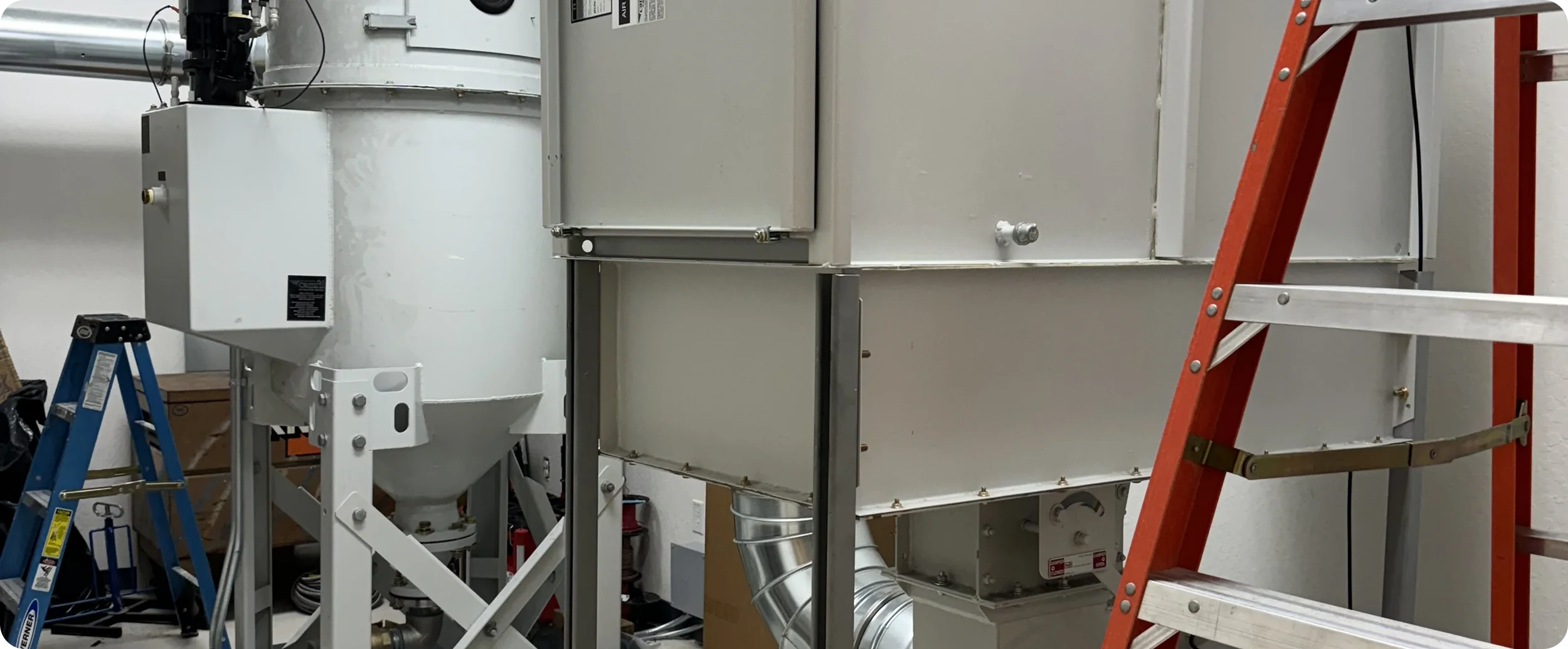
Heavy-Duty Dropout Box – Installed upstream to remove large, abrasive particles before they reached the filters, significantly reducing filter wear.
Redesigned Ductwork – Modified duct routing to eliminate moisture intrusion while improving airflow and material transport.
Collector Rehabilitation – Repaired damaged internal components and sealed air bypass leaks to restore collector performance.
System Testing & Airflow Balancing – Recommissioned and balanced the system to optimize transport velocities and dust capture efficiency.
| Results | ||
|---|---|---|
| Key Metric | Before AQE | After AQE |
| Air Quality |
Abrasive dust recirculated throughout the facility |
Clean, effective dust capture with improved worker protection |
| Filter Life |
Premature failure from moisture and abrasion |
Significantly extended service life |
| Maintenance |
Frequent cleanup, repairs, and filter replacements |
Reduced housekeeping and lower maintenance costs |
| Equipment Reliability |
Excessive wear from airborne abrasive dust |
Improved equipment protection and reliability |
Why AQE?
The best solution isn't always replacing equipment—it's understanding why the system isn't performing.
AQE engineers evaluate the complete dust collection process—from contaminant generation and airflow to filtration performance and equipment condition—to identify the root causes of system failures. That engineering-first approach allows us to restore performance, improve workplace safety, extend equipment life, and deliver practical, cost-effective solutions that maximize the value of existing systems whenever possible.
Download the Full Case Study Below
Fill out the form to get instant access to the complete case study and learn how we delivered real results for our client.